Smart mirrors
Smart mirrors: how to read LED light, colour temperature, CRI, anti-fog and IP44
Kelvin, colour rendering index, R9, protection rating: what the abbreviations in the specifications of LED bathroom mirrors mean, and how to use them to choose.
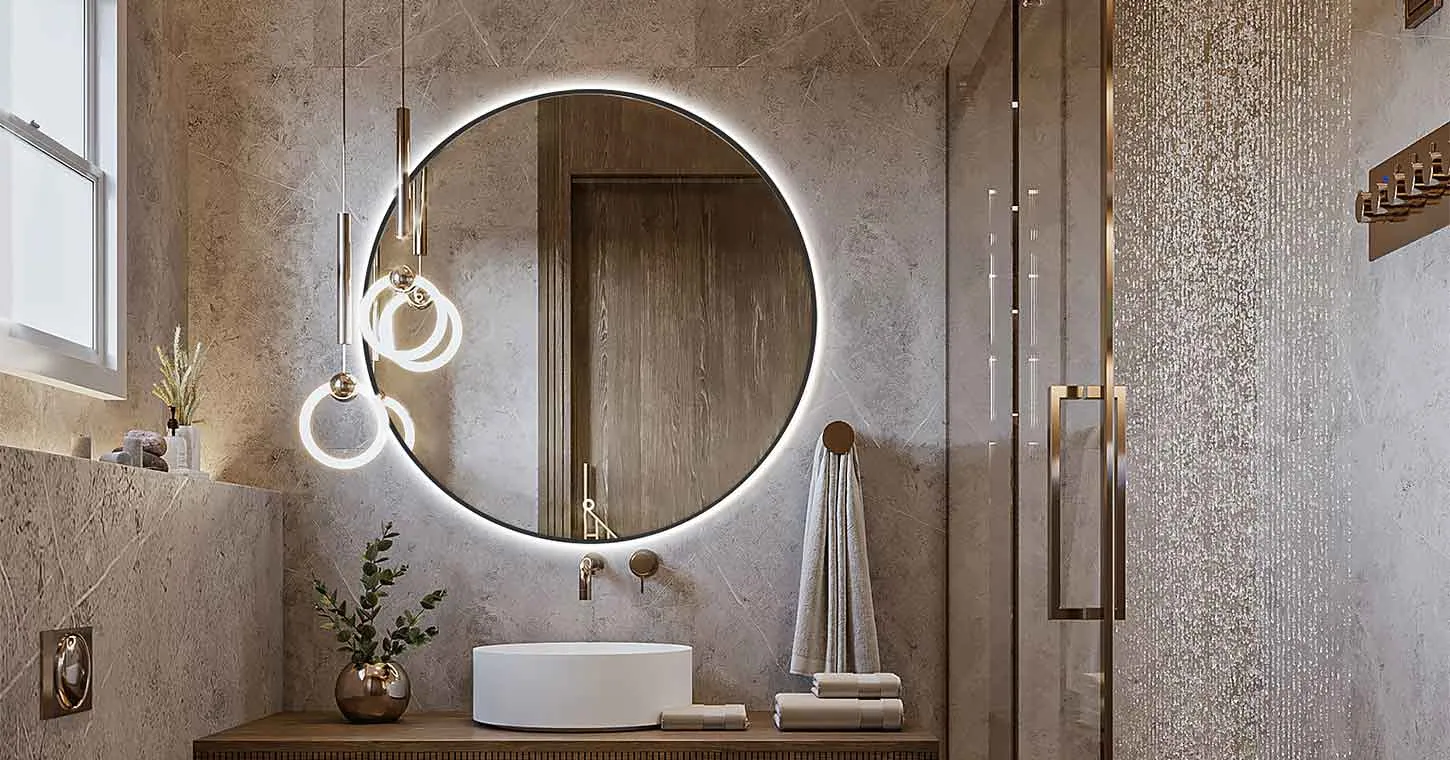
The specifications of smart mirrors are full of abbreviations: 2700-6500K, CRI 90+, Ra, R9, IP44. This is useful information, because it tells you what the light in front of the mirror will be like and how the electronics are protected. Here we explain them one by one, with the data for Keliss mirrors.
LED light
Keliss smart mirrors are lit by LED strips. According to the specifications, the strips are in waterproof epoxy resin, with 120 LEDs and 9.6 W per metre, and an integrated 12 V power supply unit gives a steady, flicker-free light. The stated LED lifespan exceeds 50,000 hours.
What changes is the way the light leaves the mirror. Some models are backlit and project a halo onto the wall, such as Stargaze; others have a perimeter light band or vertical bands on the glass, with an acrylic diffuser that makes the light even. The choice depends on use: a frontal, diffused light lights the face well, while a halo on the wall creates a softer atmosphere.
Colour temperature, in kelvin
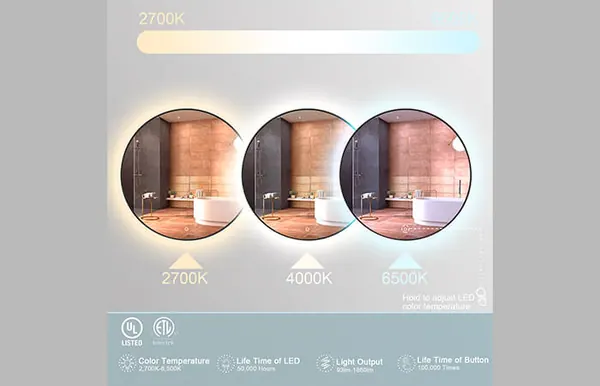
Colour temperature describes the tone of white light and is measured in kelvin (K). Low values, around 2700 K, give a warm light, similar to that of incandescent bulbs; around 4000 K the light is neutral; towards 6500 K it becomes cool, similar to daylight.
Keliss mirrors have a colour temperature adjustable from 2700 to 6500 K: you can choose a neutral or cool light for make-up and shaving, and a warm light in the evening. Adjustment is made with the touch switch on the glass, and the mirror remembers your preferred settings.
CRI, Ra and R9: colour fidelity
The colour rendering index, given as CRI or Ra, measures how faithfully a light source reproduces colours compared with a reference light. It is expressed on a scale that goes up to 100: the higher the value, the more natural colours appear. For a bathroom mirror this matters a great deal, because in front of the mirror you look at skin colour, make-up and hair.
Keliss specifications state a CRI above 90. Many models also give R9 above 50: R9 is the value that measures the rendering of saturated reds, an important component for skin tones, which the general index does not take into account.
Anti-fog
After a hot shower, steam condenses on the cold glass. Anti-fog gently warms the glass, usually with a heating pad on the back, so the glass stays clear. It is present on most Keliss mirrors, but not all: the specifications of each model state it. On Trend the anti-fog is controlled with one of the two buttons on the switch and switches itself off after an hour without being touched; on the Gaze and Enchant mirror cabinets it works on both sides of the door.
IP44: protection of the electronics
The IP code indicates the protection rating of an enclosure: the first digit relates to solid objects, the second to water. With IP44 the enclosure is protected against solid objects larger than one millimetre and against splashing water from any direction. In Keliss mirrors all the electronics are enclosed in a rust-proof metal box rated IP44.
Where to position the mirror in relation to the shower and bath, and how to connect it, is decided by the electrician in accordance with the regulations for bathrooms. Some models have a cable with a plug, others require a hardwired connection to the electrical system: this too is stated in the specifications.
The glass
According to the specifications, Keliss mirrors use 5 mm copper-free glass (for the cabinets this is not stated), with a safety film on the back that holds the fragments in the event of breakage.
To compare the models, start from the smart mirrors page. If you need help choosing, write to us.